


Уже зарегистрированы?
Введите данные для входа
Регистрация
Если у вас уже есть аккаунт, войдите через форму входа.
Аккаунт успешно создан
Поздравляем! Ваш аккаунт успешно создан.
Теперь вы можете быстрее оформлять заявки, сохранять данные и отслеживать историю обращений.
Если у вас есть вопросы по работе сайта, пожалуйста, свяжитесь с нами.
Выход из аккаунта
Вы вышли из личного кабинета.
Корзина сохранена, и товары снова появятся после следующего входа.
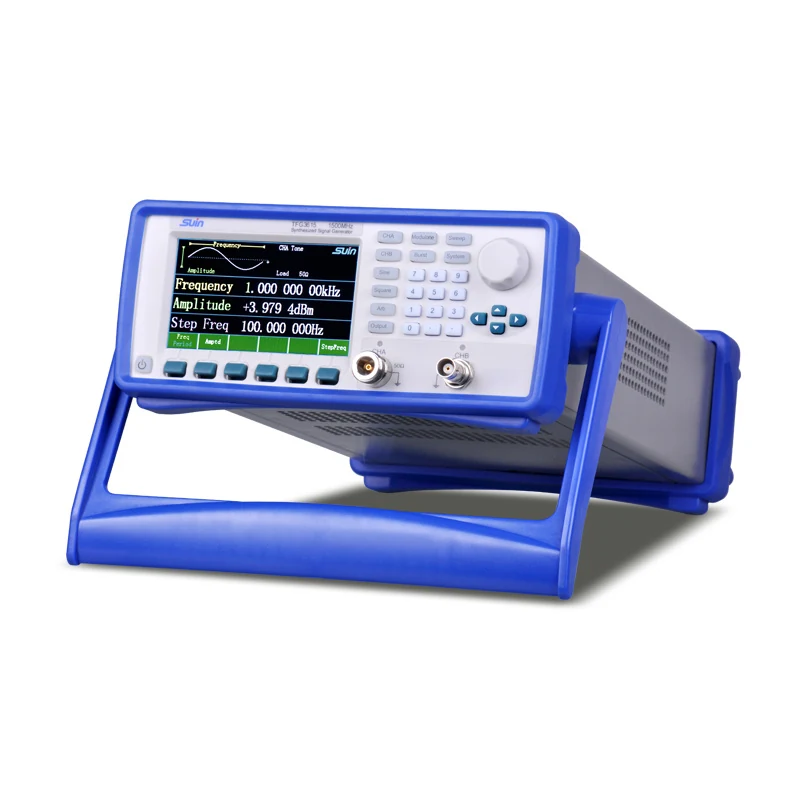
Features
* Perfect combination of DDS and PLL techniques
* Frequency upper limits to 1.5GHz
* Higher level of frequency accuracy,up to 1ppm
* Complete AM/FM/FSK/PSK modulation function
* Standard communication interface: USB Device, RS-232
Get in touch with us today to discuss your needs!
Specifications
| CHA | ||
| TFG3605 TFG3615 TFG3610 | ||
| Frequency | ||
| Range | Sine | 1μHz ~ 500MHz 1μHz ~ 1500MHz 1μHz ~ 1000MHz |
| Square | 1μHz ~ 80MHz | |
| Resolution | 1μHz (carrier frequency≤80MHz) | |
| 1Hz (carrier frequency>80MHz) | ||
| Accuracy | ±1ppm, Frequency≥1.0kHz, 18℃ to 28℃ | |
| ±50ppm, Frequency<1.0kHz, Min. output 1μHz | ||
| Sine Output Level | ||
| Range | Freq≤500MHz | -127dBm ~ +13dBm(-127dBm ~ -117dBm typical) |
| Freq≤1000MHz | -110dBm ~ +13dBm(-100dBm ~ -110dBm typical) | |
| Freq≤1500MHz | -105Bm ~ +10dBm(-100dBm ~ -105dBm typical) | |
| Resolution | 0.1dB | |
| Accuracy | Freq≤300MHz | setting ±1dBm (output level +13dBm~-100dBm) |
| Freq≤1500MHz | setting ±2.2dBm (output level +13dBm~-80dBm, setting value±1.5dBm typ. ) | |
| setting ±2.7dBm (output level -80dBm~-100dBm, setting value±2.0dBm typ.) | ||
| Stationary Wave Ratio (SWR) | < 1.8 (output level≤0dBm) | |
| Spectrum Purity | ||
| Harmonic | < -33dBc (output level≤4dBm,typical value) | |
| Non-Harmonic | < -40dBc (output level≤4dBm, deviation CF≥5kHz) | |
| Sub-Harmonic | < -40dBc (output level≤4dBm) | |
| Residual FM | < 100Hz(BW: 0.3 ~ 3kHz, RMS< 120MHz) | |
| Square | ||
| Rise/Fall Time | ≤15ns | |
| Overshoot | ≤5% | |
| Modulation | ||
| Type | AM,FM, FSK, PSK | |
| External Modulation Input |
Voltage Range: 5V full scale,Input Impedance: 10kΩ, Frequency: DC to 10kHz |
|
| Frequency Sweep | ||
| Sweep Rate | 1ms ~ 800s Linear (carrier ≤80MHz) | |
| 100ms ~ 800s Logrithm(carrier ≤80MHz) | ||
| Step Time | 50ms ~ 10s Linear (carrier>80MHz) | |
| Burst(Carrier Frequency≤80MHz) | ||
| Burst Count | 1 to 10000 cycles | |
| Interval | 0.1ms to 800s | |
| CHB | ||
| Frequency | ||
| Range | 1μHz ~ 10MHz | |
| Resolution | 1μHz | |
| Accuracy | ±1ppm, Frequency≥1.0kHz, 18℃ to 28℃ | |
| ±50ppm, Frequency<1.0kHz, Min. output 1μHz | ||
| Waveform | ||
| Type | Sine, Square, Ramp, Pulse, Sinc, Exp, Noise, DC | |
| Square | Rise/Fall Time | ≤50ns |
| Duty Cycle | 0.01% ~ 99.99% | |
| Pulse | Rise/Fall Time | ≤50ns |
| Pulse Width | 20ns ~ 20s | |
| Ramp | Symmetry | 0.0% ~ 100.0% |
| Output | ||
| Amplitude | 1mVpp to 10Vpp(50Ω), 2mVpp to 20Vpp(High Z) | |
| Offset | ±5Vpk ac+dc(50Ω), ±10Vpk ac+dc(High Z) | |
| Resolution | 5mVpp | |
| Accuracy | ±(1% of setting + 10mVpp)(1kHz Sine) | |
| Flatness | ± 0.5dB(1MHz Sine, 1Vpp) | |
| General Characteristics | ||
| Power | AC100V~240V, 50/60Hz,50VA Max | |
| Dimension & Weight | 254×103×374 mm, 4.2 kg |
|
TFG3600 Radio Frequency Signal Generator
A radio frequency signal generator, commonly known as an RF signal generator, is a critical tool in the field of electronics and telecommunications. It is used to generate precise radio frequency signals with various waveforms for testing and calibration purposes. From simple sine waves to complex modulated signals, RF signal generators play a vital role in the development, testing, and verification of electronic systems.
Applications of RF Signal Generators
RF signal generators find applications in various industries and fields, including:
Electronics Testing: Testing and characterizing electronic components, such as amplifiers, filters, and mixers.
Telecommunications: Verifying the performance of communication systems, including mobile networks and wireless devices.
Research and Development: Prototyping and testing RF circuits, conducting experiments, and exploring new designs.
Aerospace and Defense: Evaluating the performance of radar, satellite communication systems, and electronic warfare equipment.
The Technology Behind RF Signal Generators
To understand the technology behind RF signal generators, we need to explore the techniques and components that enable their precise signal generation.
Direct Digital Synthesis (DDS)
DDS is a key technique used in RF signal generators to produce precise waveforms digitally. It involves generating a digital representation of the waveform and converting it to an analog signal using a high-speed digital-to-analog converter (DAC).
Frequency Synthesizers
Frequency synthesizers are crucial components that provide stable and accurate frequency control in RF signal generators. They use phase-locked loops (PLLs) to generate precise frequencies based on the reference clock.
Modulation Techniques
RF signal generators employ various modulation techniques, such as amplitude modulation (AM), frequency modulation (FM), and phase modulation (PM), to create modulated signals for testing communication systems.
Questions & Answer
Q: What is a Radio Frequency Signal Generator?
A: An RF signal generator is an electronic device designed to produce radio frequency signals with specific characteristics. These signals are used in various applications, including testing electronic components, calibrating systems, and evaluating communication devices.
Q: What types of Radio Frequency Signal Generator?
A: RF signal generators come in different types, each catering to specific applications and requirements.
Analog Signal Generators
Analog signal generators produce continuous wave (CW) signals and basic modulated waveforms. They are simple and cost-effective but have limited flexibility in generating complex signals.
Vector Signal Generators (VSG)
Vector signal generators offer more advanced capabilities, enabling the generation of complex modulated signals used in modern communication systems. They can simulate multiple communication standards and are widely used in telecommunications testing.
Arbitrary Waveform Generators (AWG) with RF Output
AWGs with RF output combine the flexibility of arbitrary waveform generators with the capability of generating RF signals. They allow users to create custom waveforms and modulate them to generate complex RF signals.
Q: How do RF Signal Generators Work?
A: RF signal generators typically use direct digital synthesis (DDS) or frequency synthesis techniques to generate precise waveforms. The core components of an RF signal generator include:
Oscillator: The oscillator generates a stable and accurate RF carrier signal. It serves as the starting point for generating different types of modulated signals.
Frequency Control: RF signal generators offer precise frequency control, allowing users to set the desired frequency within a specified range.
Modulation Source: For generating modulated signals, the RF signal generator incorporates modulation sources such as amplitude modulation (AM), frequency modulation (FM), or phase modulation (PM).
Amplitude Control: The amplitude control feature allows users to adjust the output power level of the generated signal.
Q: Why do I need a signal generator?
A: A signal generator is a useful tool for various applications, including:
Testing and calibrating electronic devices: A signal generator can be used to send a known signal to an electronic device to test its performance or to calibrate it.
Generating reference signals: A signal generator can be used to produce a stable, accurate reference signal for use with other equipment.
Debugging circuits: A signal generator can be used to troubleshoot problems in a circuit by sending known signals and observing the behavior of the circuit.
Research and Development: A signal generator can be used in R&D to generate signals for testing new ideas or technologies.
Transmitting data: A signal generator can be used to transmit data in various applications, such as communication systems or in industrial control systems.
| Технические характеристики | |
| * Standard communication interface | U SB Device, RS-232 |
| A | RF signal generators come in different types, each catering to specific applications and requirements. | RF signal generators typically use direct digital synthesis (DDS) or frequency synthesis techniques to generate precise waveforms. The core components of an RF signal generator include: | A signal generator is a useful tool for various applications, including: |
| Accuracy: Accuracy | ±1ppm, Frequency≥1.0kHz, 18℃ to 28℃ |
| Accuracy: Burst Count | 1 to 10000 cycles |
| Accuracy: External Modulation Input | Voltage Range: 5V full scale,Input Impedance: 10kΩ, Frequency: DC to 10kHz |
| Accuracy: Freq≤1500MHz | setting ±2.2dBm (output level +13dBm~-80dBm, setting value±1.5dBm typ. ) |
| Accuracy: Freq≤300MHz | setting ±1dBm (output level +13dBm~-100dBm) |
| Accuracy: Harmonic | < -33dBc (output level≤4dBm,typical value) |
| Accuracy: Interval | 0.1ms to 800s |
| Accuracy: Non-Harmonic | < -40dBc (output level≤4dBm, deviation CF≥5kHz) |
| Accuracy: Overshoot | ≤5% |
| Accuracy: Range | 1μHz ~ 10MHz |
| Accuracy: Residual FM | < 100Hz(BW: 0.3 ~ 3kHz, RMS< 120MHz) |
| Accuracy: Resolution | 1μHz |
| Accuracy: Rise/Fall Time | ≤15ns |
| Accuracy: Stationary Wave Ratio (SWR) | < 1.8 (output level≤0dBm) |
| Accuracy: Step Time | 50ms ~ 10s Linear (carrier>80MHz) |
| Accuracy: Sub-Harmonic | < -40dBc (output level≤4dBm) |
| Accuracy: Sweep Rate | 1ms ~ 800s Linear (carrier ≤80MHz) |
| Accuracy: Type | AM,FM, FSK, PSK | Sine, Square, Ramp, Pulse, Sinc, Exp, Noise, DC |
| Aerospace and Defense | Evaluating the performance of radar, satellite communication systems, and electronic warfare equipment. |
| Amplitude Control | The amplitude control feature allows users to adjust the output power level of the generated signal. |
| Debugging circuits | A signal generator can be used to troubleshoot problems in a circuit by sending known signals and observing the behavior of the circuit. |
| Electronics Testing | Testing and characterizing electronic components, such as amplifiers, filters, and mixers. |
| Frequency | DC to 10kHz |
| Frequency Control | RF signal generators offer precise frequency control, allowing users to set the desired frequency within a specified range. |
| Generating reference signals | A signal generator can be used to produce a stable, accurate reference signal for use with other equipment. |
| Modulation Source | For generating modulated signals, the RF signal generator incorporates modulation sources such as amplitude modulation (AM), frequency modulation (FM), or phase modulation (PM). |
| Oscillator | The oscillator generates a stable and accurate RF carrier signal. It serves as the starting point for generating different types of modulated signals. |
| Pulse: Pulse Width | 20ns ~ 20s |
| Pulse: Rise/Fall Time | ≤50ns |
| Q | What is a Radio Frequency Signal Generator? | What types of Radio Frequency Signal Generator ? | How do RF Signal Generators Work? | Why do I need a signal generator? |
| Ramp: Accuracy | ±(1% of setting + 10mVpp)(1kHz Sine) |
| Ramp: Amplitude | 1mVpp to 10Vpp(50Ω), 2mVpp to 20Vpp(High Z) |
| Ramp: Dimension & Weight | 254×103×374 mm, 4.2 kg |
| Ramp: Flatness | ± 0.5dB(1MHz Sine, 1Vpp) |
| Ramp: Offset | ±5Vpk ac+dc(50Ω), ±10Vpk ac+dc(High Z) |
| Ramp: Power | AC100V~240V, 50/60Hz,50VA Max |
| Ramp: Resolution | 5mVpp |
| Ramp: Symmetry | 0.0% ~ 100.0% |
| Range: Accuracy | ±1ppm, Frequency≥1.0kHz, 18℃ to 28℃ |
| Range: Freq≤1000MHz | -110dBm ~ +13dBm(-100dBm ~ -110dBm typical) |
| Range: Freq≤1500MHz | -105Bm ~ +10dBm(-100dBm ~ -105dBm typical) |
| Range: Freq≤500MHz | -127dBm ~ +13dBm(-127dBm ~ -117dBm typical) |
| Range: Resolution | 1μHz (carrier frequency≤80MHz) | 0.1dB |
| Range: Sine | 1μHz ~ 500MHz 1μHz ~ 1500MHz 1μHz ~ 1000MHz |
| Range: Square | 1μHz ~ 80MHz |
| Research and Development | Prototyping and testing RF circuits, conducting experiments, and exploring new designs. | A signal generator can be used in R&D to generate signals for testing new ideas or technologies. |
| Square: Duty Cycle | 0.01% ~ 99.99% |
| Square: Rise/Fall Time | ≤50ns |
| Telecommunications | Verifying the performance of communication systems, including mobile networks and wireless devices. |
| Testing and calibrating electronic devices | A signal generator can be used to send a known signal to an electronic device to test its performance or to calibrate it. |
| Transmitting data | A signal generator can be used to transmit data in various applications, such as communication systems or in industrial control systems. |
| Voltage Range | 5V full scale,Input Impedance: 10kΩ, |